

“He who would trade liberty for a little temporary safety deserves neither liberty nor safety.”
— Benjamin Franklin
One of the greatest “life hacks” for a man is learning how to make money without an employer. That means operating as an independent contractor, being your own boss, and having your own “hustle” - to make a living by selling to others and cooperating with them, but not by slavishly obeying a “boss”.
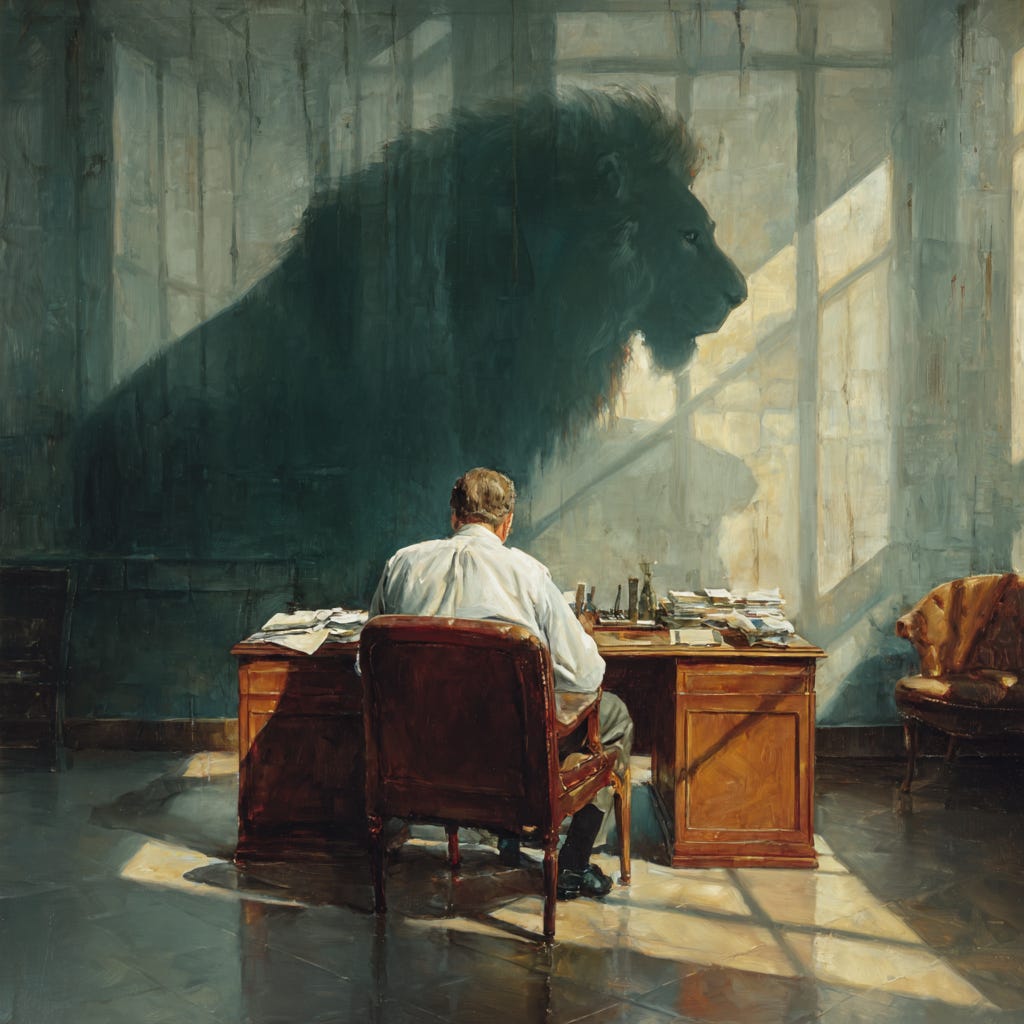
A masculine man is, in essence, a man who enjoys a large degree of autonomy in how he earns his living, which is why men who exist only as employees are, on average, far less confident and potent. Their time is not their own, and they are not building anything that belongs to them, because they are living under rulesets written by other men that generally exist not to benefit them, but the rule makers. And so they learn to suppress, dilute, and restrain their natural aggression just to secure a paycheque.
Institutional life largely functions as a low-grade humiliation ritual for men by acting as a form of spiritual castration. This is the true reason for ever declining rates of male participation in institutional life. It is not the sudden explosion of female greatness now the “shackles of oppression” have been removed, but rather the simple intolerance for and rejection of the institutions in their current form for all but the most self-effacing of men.
Institutionally, normal expressions of masculine force are treated as problems to be managed, policed, and punished. Any respectable institution - any white-collar environment especially - makes it clear: if your masculinity makes anyone uncomfortable, you will be sanctioned.
So men are, at scale, conditioned to socially mask and behave in ways that are “feminine friendly” - which in practice just means behaving less threateningly by being less authentic and more self-effacing if they are to survive professionally. The system trains a man into timidity, then chips away at his sovereignty because it is optimising for compliant functionaries rather than patriarchs.
When people ask “Where have all the real men gone?” - this is exactly why and how they have become such a rarity.
You engineered a society whose economic ladder requires men to blunt their teeth before they can climb it, by tying their status and capacity to earn a livelihood to how non-threatening and programmable they are. Unless a man finds unconventional, non-institutional ways to earn, he is required to spiritually lobotomise a great deal of his natural masculinity simply to provide for himself.
This is a loud but unspoken trade-off going on at a societal scale, and the implications of it for the birth rate, relational satisfaction and the greater human spirit are dire. The collapse of natural gender polarity puts us all out of alignment - nobody wins when one loses.
If you are a man, you want a non-career woman. If you are a woman, you want a non-institutionalised man. He needs a woman who is courageous enough to not hedge against him and feel safe in her femininity, whilst she needs a man who is free and thus potent enough not to be sterilised by academia or corporate, but grounded in his masculinity.
Contrast this with a man who works mostly around other men in blue-collar trades, or who runs his own small business. He doesn’t need to be rich, let's say he is a humble but self-employed window cleaner, for example. That man has more control over his day, and more freedom to speak and move as he pleases, and therefore possesses more agency in deciding what he tolerates and with whom he associates. And from this, comes a certain confidence. He is “more of a man”, because he carries more risk and lives with more freedom. The same is true of any business owner or person who has more say over the personal conditions by which they work.
Men who live without safety nets, who refuse the guarantee of a fixed salary in exchange for the reality of freedom, are the only men walking a masculine path. This shows in their character, their “aura”, and the way they speak and carry themselves. Men who choose permanent employment over any attempt to build even a modest side-venture, who cannot endure a bad week or month and must have the comfort of a predictable cheque almost certainly end up weaker for it.
Obedience as a primary orientation suits women more than men. Women can of course rebel, and often do in more personal contexts (which is why they are more prone to disrespect their husbands than the employers they obsequiously put in 110% for), and I say this to make the following point: organisationally, they're generally more dispositionally submissive to authority than men.
Male deference is calibrated to perceived competence and dominance: is he sharper than me, could he beat me in a fight, can he lead. Female deference is more responsive to status cues: are they more senior, institutionally powerful, more socially connected etc. A man’s reverence is tied to a sense of the other’s actual acumen, whereas a woman’s tends more towards evaluating social position.
Obeying someone simply because they have more money, or a higher position within the organisation, regardless of whether they are inherently more virtuous or competent is a feminine pattern of orientation. This is why the subordinate employee role fits women more naturally than it fits men, although paradoxically the institutions reward in women precisely what they punish in men: less warmth, and more ruthlessness - so women pay a heavy price too, because they are also repeatedly conditioned to behave in ways counter to their natural behaviour.
In simple terms: the institutions are highly androgynising in that they flatten both core masculine and feminine energy, with a bias towards an overall culture of feminine passive aggressiveness - they make men less masculine and women less feminine, then tie social inclusion and material survival to it.
This is why for a man, one of the most freeing thresholds he can cross is the point at which his survival no longer depends on people he does not like, trust, or respect.
To be financially self-reliant - to know that your bills, groceries and fundamental necessities are secured by money you generate on your own terms without dependence on bullshit workplace and institutional cultures is a profound behavioural self-affirmation that gives a man a type of confidence and natural swagger that simply cannot be counterfeited.
The true man then, in his fullest expression, does not work from within the system: but from outside of it.
To create something truly worthwhile you cannot do it alone, you need a structure especially of people willing to assist you in doing that. You need to get workers/employees in order to achieve your goal even if you have your own business. Does that make them any less of a man because theyre helping you reach your goals while also earning an honest living? Working to earn a living and helping others build doesn't take anything away from you. People work for others or in corporations/businesses to learn, for experience and so many other reasons other than just a paycheck only. Tying masculinity or a lack thereof as a trade-off to earning a paycheck is kinda surface imo albeit most white collar jobs promote more gynocentric ideals but using a steady paycheck to fund your dreams or even put food on your family's table as a person isn't that absurd and doesnt take anything away from your masculinity. I think it's an improper link tying your job to your masculinity. Sometimes a job is just a job. Once you clock out you're back to your real life. People come from different backgrounds and some aren't so lucky. As to everything in life, there are nuances. Things aren't so black and white. That being said, I love your work been following you since your IM days. Big fan!
Insightful,Mindfucking,inspirational, masculine soul awakening and a great masterpiece ⭐